Most trend lists promise a revolution. The sales trends 2027 will actually be built on are quieter and more practical: who reads your documents, when they read them, and how much of the decision happens before you join the conversation.
The short version: buyers research alone with AI, then come to sellers to check what they found. Buying groups are bigger and procurement arrives earlier. Every purchase and renewal faces an ROI test. And the proposal, deck or statement of work you send now does more selling than the call that came before it.
This guide covers 11 B2B sales trends for 2027, grouped by buyers, sellers and deals. Each one comes with the research behind it and a specific change to make in the documents you send, from proposals and quotes to SOWs and renewal proposals. It closes with a document-by-document breakdown, a 90-day plan and the metrics worth tracking, plus where AI-powered document generation fits into the workflow.
Sales Trends 2027 at a Glance
Use this table as a quick reference. Each trend is covered in detail below.
| Trend | What is changing | What to change in your documents |
|---|---|---|
| 1. Rep-free research | Buyers prefer to research and evaluate without a rep | Make every document readable without a walkthrough |
| 2. AI-first buyer research | Buyers start with AI, then validate with humans | Back claims with proof a buyer can check |
| 3. Bigger buying groups | More stakeholders, procurement involved from the start | Structure documents so each role finds its section fast |
| 4. ROI scrutiny | Budgets are tight, renewals get questioned | Lead with outcomes and numbers, not features |
| 5. Trials before commitment | Most buyers test before a full purchase | Send pilot proposals with clear success criteria |
| 6. AI-first selling | AI starts research, prep and first drafts | Connect research directly to document creation |
| 7. Relevance over volume | Buyers avoid suppliers who send generic material | Tailor every document to the client’s context |
| 8. Creating inside AI assistants | Sellers work inside AI chat tools | Generate branded documents from the same chat |
| 9. Mid-funnel stalls | Most purchases stall at some point | Track engagement and follow up on what was read |
| 10. Consistency as trust | Buyers compare every channel for contradictions | Pull all documents from one maintained library |
| 11. The close moves inside the document | Every extra step after yes adds delay | Put signature and payment in the shared link |
B2B Sales Trends 2027: How Buyers Will Buy
The first five trends sit on the buyer’s side. They change who reads your documents, what those readers expect, and how much they already know before you speak to them.
1. Buyers Finish Most of the Research Before They Contact You
A Gartner survey published in March 2026 found that 67% of B2B buyers prefer a rep-free experience, up from 61% a year earlier. The same survey found that 45% of buyers had used AI during a recent purchase.
Your proposal is often the only version of your pitch that reaches the whole buying group. It gets shared with people who never joined the discovery call, and they read it without you there to explain anything.
What to change: write every document to stand on its own. State the client’s problem in their words, the outcome they get, the price, and the next step. If a section only makes sense with a verbal walkthrough, rewrite it.
Want documents that sell when you are not in the room? Create your first branded document free.
2. AI Becomes the Buyer’s First Research Tool and Their Biggest Doubt
Forrester’s State of Business Buying, 2026 report, as covered by Digital Commerce 360, found generative AI tools were the single most cited meaningful interaction type buyers used to research purchases. The same research found 20% of buyers felt less confident in a decision because they hit unreliable or inaccurate AI information.
So buyers check. Gartner’s May 2026 buyer research found that 69% of B2B buyers prefer to validate AI-generated insights with a sales rep. Looking further ahead, Gartner predicts that by 2028, 90% of B2B buying will be AI agent intermediated. AI will read and summarise your documents long before a human signs one.
What to change: give buyers proof they can verify and give AI summarisers a clean structure to read. Use named outcomes from similar clients, explicit scope, stated assumptions and pricing with no hidden lines. Clear headings and self-contained sections help a human skim and help an AI summary get your offer right.
3. Buying Groups Grow Wider and Procurement Arrives Early
According to the same Forrester research, an average of 13 internal stakeholders and nine external participants influence a B2B purchase. Procurement was named as a decision-maker by 53% of respondents and is now involved from the earliest stages, asking for more than just price.
One document, many readers. The CFO reads pricing. The end user reads implementation. Procurement reads terms, scope and value. The sponsor reads the executive summary and stops there.
What to change: structure documents for skimming by role. Use an executive summary that stands alone, pricing in its own block, and scope kept separate from sales copy. Send one link to everyone so every stakeholder reads the same current version. Bigger groups also mean longer cycles, so put proven strategies to shorten the B2B sales cycle into practice early.
4. Every Purchase and Renewal Faces an ROI Test
Forrester names intensified scrutiny of business value as one of three forces reshaping B2B buying. Buyers are tightening budgets and examining renewals as closely as new purchases, with efficiency and productivity the strongest drivers for renewals and add-ons.
Gartner’s March 2026 research points the same way. Buyers who feel confident in their decision are twice as likely to report a high-quality deal, and Gartner ties that confidence to value clarity: a clear understanding of how a solution improves outcomes in the buyer’s specific role and business context.
What to change: open with the client’s problem, put the outcome in their numbers, and tie every line item to a result. For a working framework, start with value-based selling in proposals. Treat renewals as a sale, not an invoice: show what the client got last year before asking for next year.
5. Buyers Want to Try Before They Commit
Forrester found that more than 60% of buyers ran some form of trial before committing to a full purchase. Trials do not guarantee the deal, though: 35% of buyers said they planned to convert with a different provider after a trial.
A trial without agreed success criteria is a free product tour. The buyer finishes it, compares notes with a competitor, and the conversation starts again.
What to change: send a short pilot proposal before any trial starts. Define the scope, the success metrics, who is involved, the timeline, and what happens on day one after a successful pilot. When the trial ends, the full proposal writes itself from the agreed criteria.
Sales Team Trends: How Sellers Will Work in 2027
The next three trends sit inside your own team. They change how fast documents get made and how specific they need to be.
6. AI Starts Every Seller Workflow
Gartner predicts that by 2027, 95% of sellers’ research workflows will begin with AI, up from less than 20% in 2024. Account research, call prep and first drafts are turning into machine work.
That moves the bottleneck downstream. Research gets faster, but someone still turns it into a client-ready document that looks like your company. A chat window gives you text. It does not give you your logo, your pricing table, a trackable link or a signature block. That gap is exactly why ChatGPT, Gemini and Claude cannot replace a proposal tool on their own.
What to change: connect the research step to the document step. The prospect’s context, from the call notes to the requirements, should flow straight into a branded draft instead of being copied into a template by hand.
7. Relevance Beats Volume
Gartner’s June 2025 sales survey found that 73% of B2B buyers actively avoid suppliers who send irrelevant outreach. That penalty does not stop at cold email. A proposal that reads like it went to ten other prospects tells the buyer the same thing.
AI makes generic content cheap, so buyers see more of it and trust it less. The documents that stand out reference the client’s industry, their stated goals and their own language from the discovery call.
What to change: keep your reusable content (services, case studies, team bios, pricing) in one place, and spend the time you save on the parts only this client gets: the problem statement, the outcome and the plan. The Smart Content Library in Proposal.biz extracts that reusable content from your website URL once, so every draft starts with your facts and you only write what is specific to the deal.
8. Documents Get Created Inside AI Assistants
Reps already draft emails, summarise calls and research accounts inside an AI assistant. The next step is creating the client document from the same chat, without opening another tab or rebuilding the draft somewhere else.
You can connect Proposal.biz to the AI assistant your team already uses, describe the document you need, and Proposal.biz builds the branded version and returns a link. Your assistant handles the conversation. Proposal.biz handles the document, with your logo, colours, fonts and pricing already applied.
What to change: map where your team spends its working day and remove the copy-paste steps between research and document. This B2B sales trend matters most for small teams, where one person prospects, runs the demo and writes the proposal.
Deal Trends: How B2B Deals Will Move and Close in 2027
The last three trends cover the stretch between sending a document and getting paid, where most deals are won or lost quietly.
9. Deals Stall in the Middle Unless You Can See Them
Forrester’s 2024 buying research found that 86% of B2B purchases stall at some point in the buying process. With bigger groups, earlier procurement and tighter budgets, that pressure is not easing.
The worst part of a stall is not knowing it has started. You send the proposal and hear nothing. Is the buyer reading it, circulating it internally, or ignoring it?
What to change: stop sending static attachments. Document analytics and engagement tracking show when a document was opened and how far the client scrolled, so a follow-up becomes a message about the part that needs attention instead of “just checking in”.
Stop guessing what happens after you hit send. Start free and track your next proposal.
10. Consistency Across Every Channel Becomes a Deciding Factor
McKinsey’s 2026 Global B2B Pulse found that buyers use an average of ten channels across the purchasing journey, and that inconsistent information is now one of the leading drivers of supplier switching.
Buyers compare your website, the AI summary of your website, your rep’s pitch and your proposal. Documents copied from a previous deal drift fastest: old pricing, retired service names and last year’s logo all slip through.
What to change: fix it at the source with one content library, maintained once, feeding every document. This is where sales and marketing alignment becomes daily practice. Marketing owns the messaging, and sales uses it in every proposal without rewriting it.
11. The Close Moves Inside the Document
When a buyer is ready to commit, every extra step is another chance to stall. Download the PDF, print it, sign it, scan it, wait for the invoice, find the card. Each handoff costs days, and a bigger buying group means more people who need to complete each one.
What to change: put the close in the same place as the pitch. In Proposal.biz, e-signatures sit inside the shared link, signing records the status and date, and both parties receive a confirmation email. Payment collection through payment integration lets the client pay at the point of signing. Draft, send, sign and get paid without switching tools.
What These Trends Mean for Each Sales Document
Trends are only useful when they change what you send. Here is how they apply to the documents B2B sales teams produce most often.
Proposals
Write for a reader who missed every call. Open with a one-page executive summary that states the problem, the outcome and the investment. Keep pricing in its own block, scope in its own section, and proof (case studies, results, team) close to the claims it supports.
Pitch and Sales Decks
Decks now get read more often than they get presented. Every slide needs a headline that makes the point on its own, so a stakeholder flicking through it alone still follows the argument. Put one clear outcome on the final slide, not a generic thank-you.
Quotes and Pricing Documents
Procurement reads these first and reads them hardest. Show what each line item delivers, separate one-off and recurring costs, state what is excluded, and make the total impossible to misread. A quote that needs a call to explain it is a quote that stalls.
Statements of Work
Bigger buying groups mean more people interpreting the same scope. List deliverables, milestones, responsibilities on both sides, assumptions and the change process in plain language. Vague scope is the fastest route from signed deal to awkward renegotiation.
Renewal and Expansion Proposals
Treat renewals as a new sale with an evidence advantage. Lead with what the client achieved in the last term, connect it to the efficiency gains they care about, then present the renewal or upsell as the next step in that story.
How To Prepare Your Sales Team for 2027: A 90-Day Plan
You do not need a new sales methodology to act on these trends. You need better documents and a faster way to produce them. This plan fits around a normal quarter.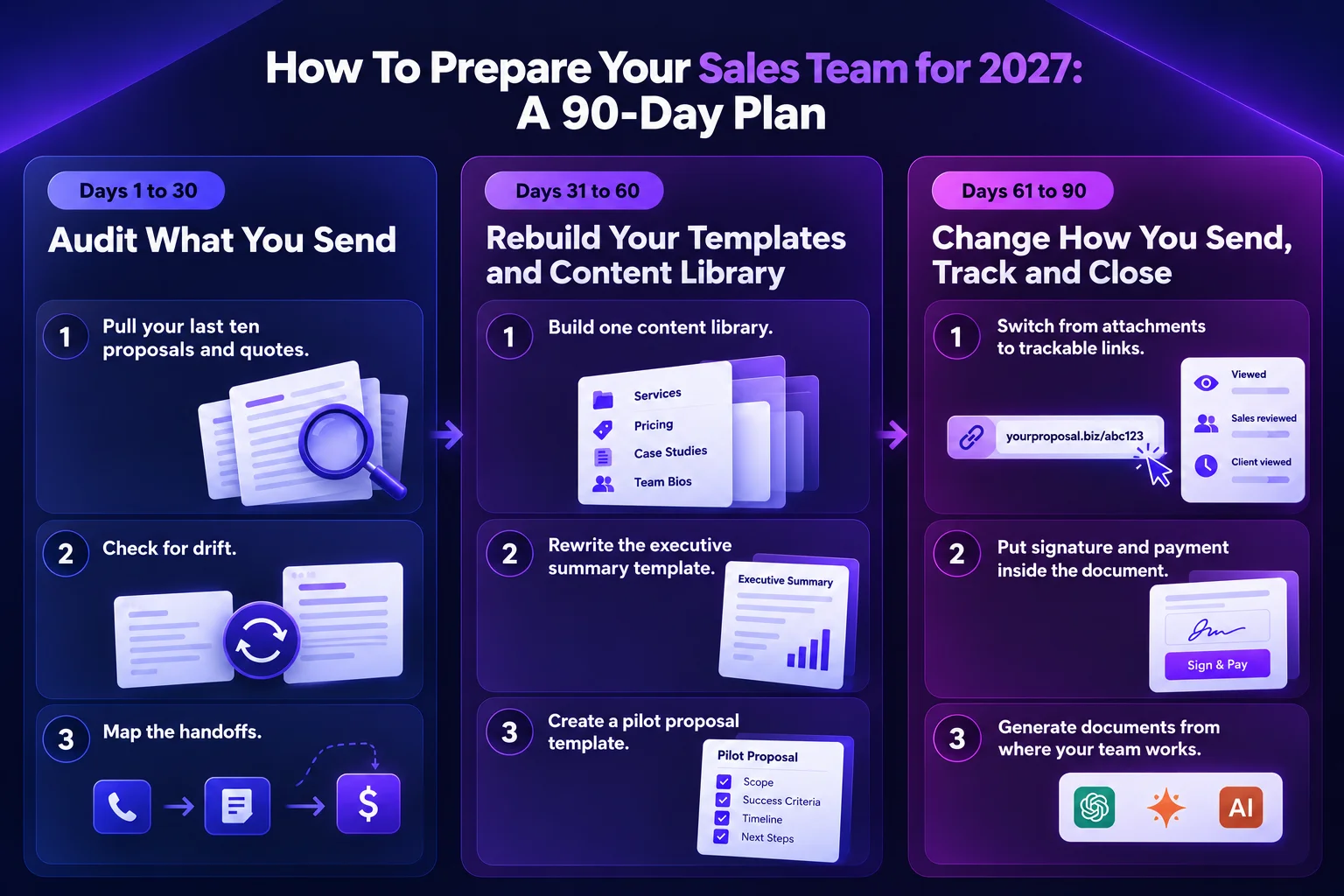
Days 1 to 30: Audit What You Send
- Pull your last ten proposals and quotes. Read each one as a stakeholder who never spoke to your team. Mark every section that depends on a verbal explanation.
- Check for drift. Compare pricing, service names, case studies and branding in those documents against your website today.
- Map the handoffs. List every tool and step between a discovery call and a paid invoice, and note where deals tend to go quiet.
Days 31 to 60: Rebuild Your Templates and Content Library
- Build one content library. Services, pricing, case studies and team bios, kept current in one place and pulled into every document.
- Rewrite the executive summary template around the client’s problem, the outcome in their numbers and the investment.
- Create a pilot proposal template with scope, success criteria, timeline and next steps, ready for any buyer who asks for a trial.
Days 61 to 90: Change How You Send, Track and Close
- Switch from attachments to trackable links so every stakeholder reads the current version and you see when it is opened.
- Put signature and payment inside the document so a yes turns into revenue without another round of emails.
- Generate documents from where your team works, including the AI assistant they already use for research and call notes.
Sales Metrics Worth Tracking in 2027
These metrics show whether your documents are keeping up with the way buyers now buy. Track them per document type, not just per deal.
| Metric | Why it matters in 2027 | How to measure it |
|---|---|---|
| Time from discovery call to document sent | Buyers who have already done their research expect a fast, specific response | Hours or days between the call and the sent link |
| Time from send to first open | A slow first open signals the document is not reaching the right person | Engagement data on the shared link |
| Scroll depth | Shows whether readers reach pricing, scope and next steps | How far the client scrolled through the document |
| Time from open to signature | Reveals how long the buying group takes to agree after reading | Days between first open and signed status |
| Time from signature to payment | Every day here is revenue you have earned but not collected | Days between signed status and payment |
| Stall point | Tells you which stage needs a better document or follow-up | The last action before a deal goes quiet |
Final Word
Sales trends 2027 all point the same way. Buyers decide more on their own, in bigger groups, with AI in the loop and a sharper eye on value. Your rep’s voice reaches fewer of those moments. Your documents reach every one of them.
The teams that win will draft faster, write for every reader, send links instead of files, see what happens after sending, and close inside the document. Proposal.biz puts that whole lifecycle in one window: paste your URL, generate a branded document from a prompt, share it, track it, collect the signature and get paid.
Frequently Asked Questions
What are the biggest sales trends for 2027?
The biggest shifts are buyer-led research, AI at the start of both buyer and seller workflows, larger buying groups with earlier procurement involvement, stricter ROI scrutiny, trials before purchase, and mid-funnel stalls. Together they move more of the selling into the documents buyers read on their own.
Which B2B sales trends 2027 matter most for small sales teams?
Small teams gain the most from three changes: creating documents inside the tools they already use, reusing one content library instead of rebuilding each proposal, and closing with signature and payment in the same document. Each removes manual work a lean team feels on every deal.
How will AI change B2B sales in 2027?
AI takes over research, call prep and first drafts for sellers, and becomes the starting point for buyer research. Sellers spend less time gathering information and more time validating what buyers have already found and turning it into a finished, specific client document.
Do B2B buyers still want to talk to sales reps?
Yes, at specific moments. Most buyers prefer to research without a rep, but a majority still turn to a seller to confirm AI-generated insights before they commit. Reps who arrive with specifics and verifiable proof earn that conversation.
How should proposals change to match sales trends 2027?
Proposals should stand on their own for readers who missed every call, open with the client’s problem and outcome in their numbers, separate pricing and scope for different stakeholders, and be shared as a trackable link with signing and payment built in.
What is a pilot proposal and when should you send one?
A pilot proposal is a short document that agrees the scope, success metrics, timeline and next steps of a trial before it starts. Send one whenever a buyer asks to test your product or service, so the trial ends with an agreed decision point rather than an open question.
Why do so many B2B deals stall after the proposal is sent?
Bigger buying groups, competing priorities and tighter budgets slow agreement inside the client’s company. Sellers usually find out late because they have no visibility after sending. Seeing when a document is opened and how far it is read shows where to follow up.

Join Our Newsletter
Subscribe to our newsletter to get the latest updates and offers
This site is protected by reCAPTCHA and the Google Privacy Policy and Terms of Service apply.
* Will send you weekly updates for your better business management.