
The best sales practices aren’t about memorizing scripts or perfecting your pitch delivery. They’re about understanding how buyers actually think and make decisions. When you match your approach with the psychological principles that govern human behavior, you stop pushing. You start guiding prospects toward choices they feel good about. Most sales training ignores this reality, teaching tactics that clash with modern buyer psychology and the cognitive biases that shape every purchasing decision . Test.
This guide walks you through eight evidence-based practices that work with human psychology, not against it. You’ll discover how reciprocity creates natural obligations. You’ll see why social proof influences B2B buyers more than features. You’ll learn how framing your message around loss aversion changes response rates. Each practice connects to specific psychological triggers you can apply in your next sales conversation. These triggers build trust, reduce resistance, and help buyers commit with confidence.
The Reciprocity Principle: Give Value Before Asking
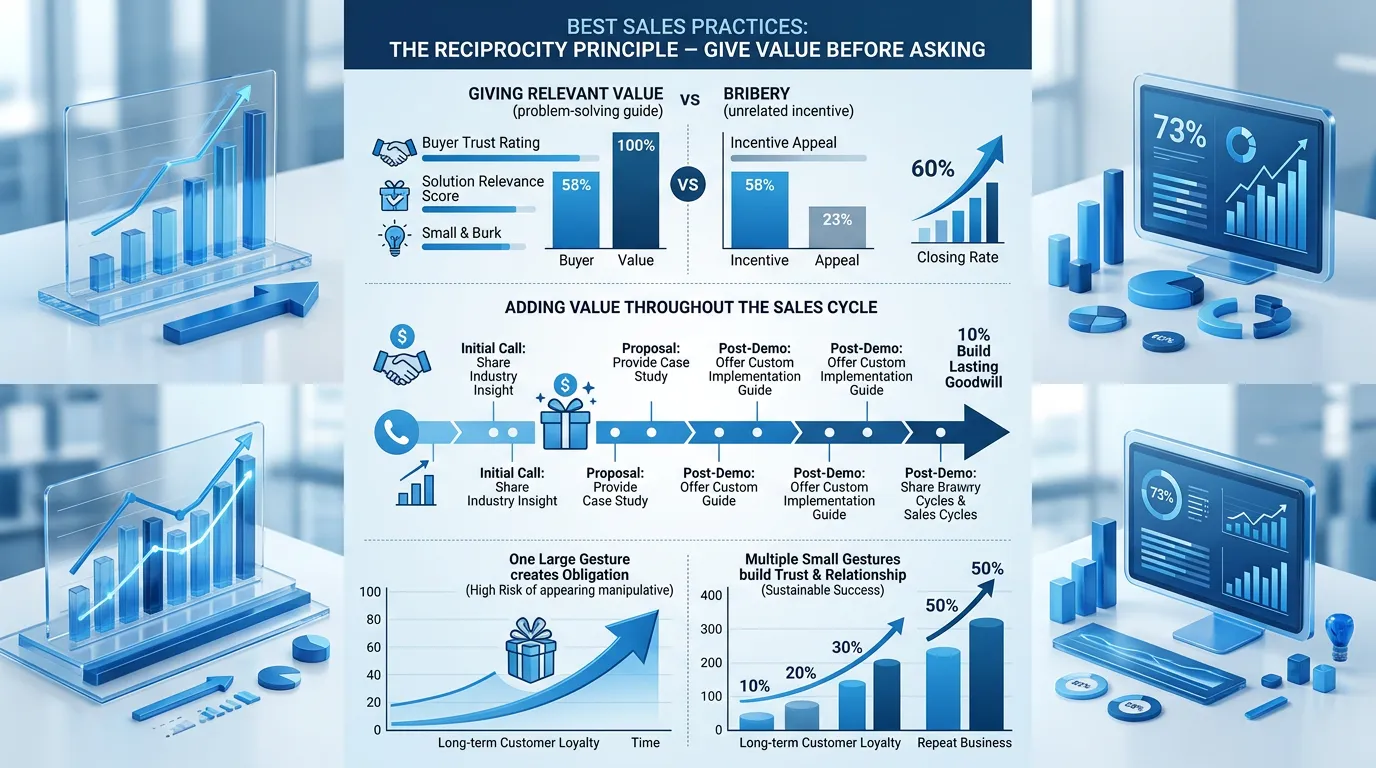
When you provide unexpected value before making an ask, you create a psychological debt that buyers feel compelled to repay. This reciprocity bias operates automatically, making prospects more receptive to your eventual pitch.
Why Free Value Creates Obligation
Reciprocity works because humans are hardwired to return favors. When you offer something valuable without strings attached, buyers feel an internal pressure to reciprocate.
The key is providing value that costs you effort but delivers real utility to the prospect. A custom competitive analysis for their market segment carries more weight than a generic whitepaper.
According to Pipedrive’s guide to psychological selling principles, this approach differs from bribery. The value relates directly to solving the buyer’s problem rather than serving as an unrelated incentive.
Implementing Strategic Reciprocity in Sales Cycles
Timing matters. Offer value early in discovery, not immediately before asking for the sale. Free audits, industry benchmarking data, or custom research reports work best when they help prospects understand their situation better.

For example, a software vendor might analyze a prospect’s current workflow and identify three bottlenecks before ever mentioning their product. This positions you as a trusted advisor rather than a transactional seller.

UploadRefine
Space your value-adds throughout the sales cycle. One substantial gesture creates obligation; multiple smaller ones build lasting goodwill without appearing manipulative.
Social Proof and Authority: Leveraging Consensus Bias
Buyers rarely make decisions in isolation. They look to peers, industry leaders, and similar companies for validation before committing to a purchase.
This tendency stems from consensus bias, where people assume that if others made a choice, it must be the right one. Research from the National Center for Biotechnology Information shows how cognitive biases affect decision-making in professional contexts, making social proof a powerful sales tool.
Types of Social Proof That Influence B2B Buyers
Client logos from recognizable brands signal credibility instantly. Display them on proposals and presentations to show you’ve worked with respected companies.
Case studies with specific results carry more weight than vague testimonials. Instead of “great service,” share “reduced processing time by 40% in three months.”
Industry awards and certifications establish third-party validation. They show independent experts have vetted your work.
Many businesses use Proposalbiz to create professional proposals that showcase client testimonials and results in a polished format.
Building Authority Through Expert Positioning
Buyers trust experts who demonstrate deep knowledge of their specific challenges. Share original research, publish thought leadership content, and speak at industry events.
Introduce social proof early in discovery calls. Mention a similar client’s challenge and how you solved it. This builds confidence that you understand their situation.
Combine authority with specificity. Don’t say “we help companies grow.” Say “we helped a logistics company reduce delivery costs by 23% through route optimization.”
Scarcity and Urgency: The Psychology of Limited Availability
Scarcity taps into loss aversion, a cognitive bias where people fear missing out more than they value gaining something new. When buyers perceive limited availability, they act faster to avoid regret. According to Sparklight Business, scarcity drives demand by increasing perceived value and creating urgency.
Real vs. Artificial Scarcity in Sales
Legitimate scarcity stems from genuine constraints: limited consulting spots, seasonal pricing windows, or capacity restrictions. These create natural urgency without manipulation. This is covered in detail in scarcity drives demand.

Artificial scarcity damages trust when buyers discover fake deadlines or manufactured limitations. Countdown timers that reset daily or “last chance” offers that repeat weekly erode credibility and harm long-term relationships.
Many teams using Proposalbiz frame deadlines around project timelines rather than arbitrary cutoffs, which keeps urgency authentic.
Creating Ethical Urgency Without Pressure Tactics
Frame deadlines around buyer benefits instead of seller convenience. “This pricing locks in before the Q2 rate adjustment” works better than “My quarter ends Friday.”
Combine scarcity with clear value propositions. Buyers should understand what they gain, not just what they’ll lose. When urgency stands alone, it appears desperate. When paired with concrete ROI data, it becomes a legitimate decision factor that respects the buyer’s intelligence.
Anchoring Effect: Setting the Right Reference Points
How Initial Numbers Shape Perception
The first number a buyer hears becomes their mental benchmark for evaluating all subsequent information. Research from the Federal Reserve Bank of St. Louis demonstrates how initial price points shape purchasing decisions, even when buyers know they’re being influenced.
This cognitive bias works because our brains latch onto the first piece of information as a reference point. When you mention a premium package at $50,000 before discussing your standard $25,000 option, the latter suddenly feels more reasonable. For a deeper look, see anchoring effect on purchasing.
Buyers rarely adjust far enough from that initial anchor, even with additional information. The first number sets the frame for the entire conversation.
Strategic Pricing Presentation Techniques
Present your premium options first to make standard offerings appear more accessible. A consulting firm might open with their $100,000 enterprise solution before introducing their $40,000 mid-tier package.
Use competitor pricing or the buyer’s previous spending as anchors during negotiations. Reference what they currently invest to frame your solution as comparable or better value.
Reframe price discussions around ROI and measurable outcomes rather than cost alone. Instead of defending a $30,000 price tag, discuss the $150,000 in revenue it could generate.
Avoid negative anchors that position your solution as the expensive choice. Never say “We’re not the cheapest option” without immediately following with concrete value differentiation.
The Commitment and Consistency Principle
People naturally act in ways that align with their previous statements and actions. This commitment bias drives buyers to follow through once they’ve agreed to something, no matter how small.
Small Commitments Lead to Larger Ones
Start with minor agreements before requesting major decisions. Ask prospects to confirm meeting times, acknowledge specific business challenges, or agree that a problem exists.
These small yeses create psychological momentum. When a buyer says “Yes, we struggle with lead qualification,” they’ve committed to a position that makes your solution more relevant.
Written commitments carry even more weight. In B2B sales, documented agreements like signed meeting notes or emailed problem statements strengthen consistency bias.
Building Agreement Momentum Throughout Sales Conversations
Use trial closes throughout your conversation. Questions like “Does this approach make sense so far?” or “Can you see this working for your team?” build progressive agreement.
Each micro-commitment moves buyers closer to the final decision. When they’ve agreed five times during a presentation, saying no at the end contradicts their established pattern.
Avoid seeking commitment before establishing value. According to the Federal Trade Commission, ethical sales practices require demonstrating genuine benefits before asking for decisions. Premature requests trigger resistance and damage trust.
Framing and Loss Aversion in Sales Messaging
People feel losses twice as strongly as equivalent gains. This psychological principle shapes how buyers respond to your message.
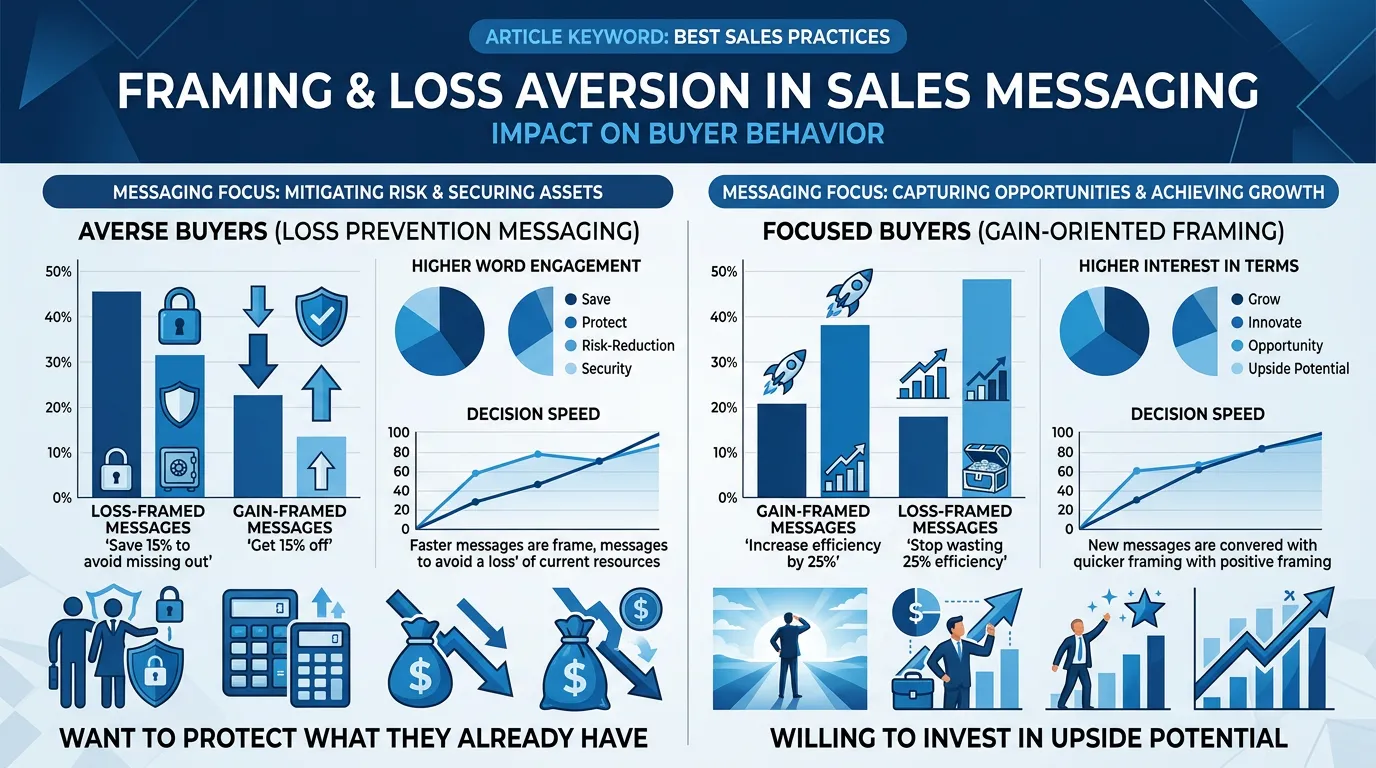
When you present a solution, the way you frame it changes its perceived value. A 10% cost reduction feels less compelling than avoiding a 10% revenue loss, even though the financial impact is identical.
Positive vs. Negative Framing Strategies
Negative framing highlights what buyers will lose by not acting. This works when discussing competitive threats, regulatory deadlines, or market shifts.

A software vendor might say: “Without automation, your team will continue spending 15 hours weekly on manual data entry while competitors gain efficiency advantages.”
Positive framing emphasizes growth and opportunity. Use this approach when selling innovation, expansion tools, or new capabilities that help buyers reach aspirational goals.
When to Emphasize Gains vs. Preventing Losses
Risk-averse buyers respond better to loss prevention messaging. They want to protect what they already have.
Growth-focused buyers prefer gain-oriented framing. They’re willing to invest in upside potential.
The most effective presentations combine both frames. Start with the cost of inaction, then pivot to the gains your solution delivers. This complete approach addresses both psychological drivers.
The Decoy Effect and Choice Architecture
Designing Option Sets That Guide Decisions
The decoy effect works by introducing a third option that makes your target choice look better by comparison. When buyers see three options instead of two, they naturally compare them, and a strategically placed decoy highlights the value of your preferred package.
This asymmetric dominance effect appears most clearly when the decoy is slightly inferior to your target option but priced similarly. A software package priced at $99 with basic features makes the $129 premium package look like a bargain. The premium package offers advanced features when compared to a $119 option with only moderate improvements.
Limiting choices to three substantial tiers prevents decision paralysis. Too many options overwhelm buyers and delay decisions, while three options create clear differentiation without cognitive overload.
Three-Tier Pricing Psychology
Good-better-best pricing structures naturally draw attention to the middle option. Most buyers avoid the cheapest tier, fearing they’ll miss critical features, and hesitate at the premium tier unless they have specific needs.
Feature comparison tables make this psychology visible. List your three tiers side by side, highlighting where the middle option delivers the most value per dollar. Bold the features that matter most to your typical buyer in the center column.
The middle tier typically converts 60-70% of buyers when positioned correctly between a basic option and a premium choice with specialized features.
Mirroring, Rapport, and the Similarity Principle
Buyers naturally trust people who remind them of themselves. This similarity bias shapes purchasing decisions more than most sellers realize, creating opportunities to build connection through subtle behavioral coordination.
Building Unconscious Connection Through Behavioral Matching
Match your prospect’s communication style without mimicking them. If they speak quickly and get straight to business, skip the small talk. When they lean back and share stories, slow your pace.
Energy levels matter too. A reserved buyer feels uncomfortable with high enthusiasm, while an animated decision-maker finds monotone delivery disengaging.
Adapt your presentation approach to their preferences. Data-focused buyers want spreadsheets and metrics. Relationship-oriented prospects respond better to customer stories and collaborative discussion.
Finding Common Ground Strategically
Look for real shared experiences before meetings. LinkedIn profiles reveal alma maters, previous employers, and professional interests that create natural conversation bridges.
When you discover commonalities during conversations, acknowledge them briefly without forcing connection. A simple “I worked in that industry too” builds rapport better than dwelling on coincidences.
Sincerity sets the limit. Forced mirroring feels manipulative and damages trust. Stay real while adjusting your approach to make prospects comfortable, not to trick them into buying.
Conclusion
The best sales practices work because they respect how buyers actually think and decide. You don’t need to master all 15 principles at once. Start by auditing your current sales process to identify where you already apply these psychological principles and where opportunities exist. Pick two or three that match your sales context and test them systematically over the next 30 days.
Track your conversion rates, note which approaches resonate with your specific buyers, and refine your method based on real results. The goal isn’t manipulation, it’s making buying decisions easier and more confident for your prospects. When you structure your sales approach around proven psychological principles, you help buyers see value clearly and act with confidence.
Ready to build proposals that apply behavioral science automatically? Proposalbiz helps you create persuasive, professional sales documents that incorporate these psychological principles at scale. You can focus on conversations while your materials do the heavy lifting.
Key Takeaways
-
You can increase response rates by providing unexpected value first through free audits or custom research before asking for the sale, triggering the reciprocity principle.
-
You should present your premium option first during pricing discussions to anchor buyers at a higher reference point, making your standard offering appear more reasonable.
-
You’ll reduce decision paralysis by structuring your packages in a good-better-best format with no more than three options. Use the decoy effect to guide buyers toward your preferred tier.
-
You can build faster trust by matching your communication style and pace to your buyer’s preferences, using the similarity principle to create natural rapport.
-
You’ll see higher conversion rates when you frame solutions around what buyers will lose by not acting. Loss aversion makes people feel potential losses twice as strongly as equivalent gains.
You've read the blog. Get your personalized prompt pack now.
Tailored to your exact document type, sent straight to your inbox.
No Credit Card.
Get a personalized prompt pack for your exact use case.
Pick your document type and we'll send it straight to you.
No Credit Card.

Join Our Newsletter
Subscribe to our newsletter to get the latest updates and offers
This site is protected by reCAPTCHA and the Google Privacy Policy and Terms of Service apply.
* Will send you weekly updates for your better business management.