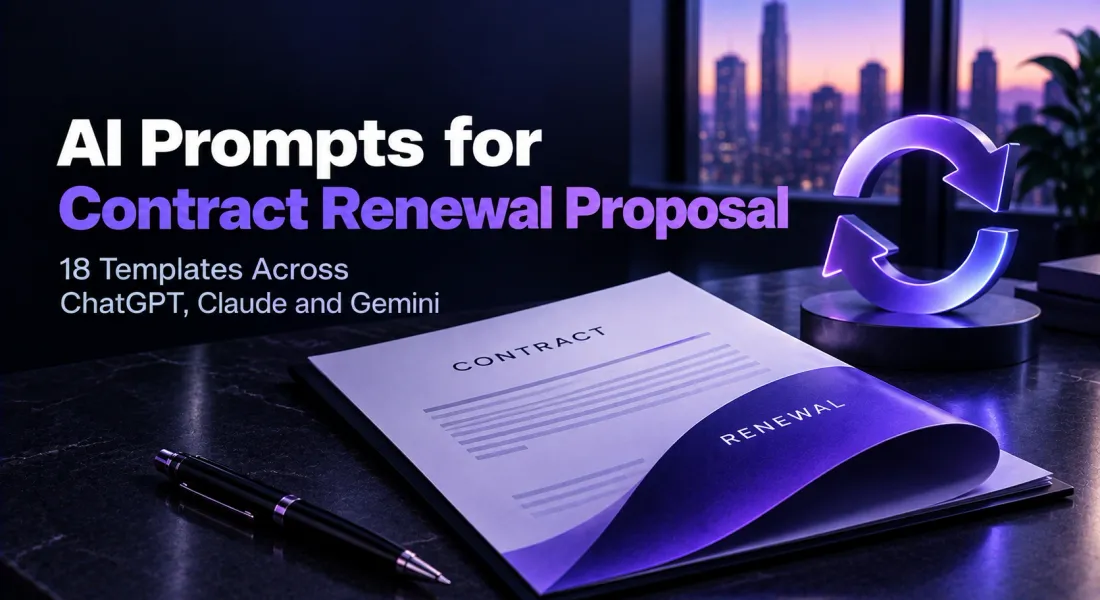
A contract renewal proposal is the easiest sale a business ever makes, or the easiest one to lose through sheer neglect. The customer already knows the product, already has a relationship with the team, and already has a track record to point to, yet many renewals go out as a flat repeat of last year’s terms with a new date, missing the obvious chance to show growth and expand the account. Most renewal proposals either read as an afterthought, a price and a signature line, or oversell so hard it feels like a first-time pitch to someone who has been a customer for two years.
The 18 templates here, divided across ChatGPT, Claude and Gemini, treat a renewal as a results conversation first, a commercial ask second. The ChatGPT prompts cover full renewal proposals, upsell framing and at-risk account saves. The Claude prompts handle usage-data-backed renewals, multi-year structures and win-back proposals for lapsed accounts. The Gemini prompts research the customer’s current situation and industry context so the renewal reads as genuinely informed, not auto-generated from a billing system.
Why AI Works Well For Contract Renewal Proposals
A contract renewal proposal is a short document backed by a real account history, the same evidence-based discipline behind any strong proposal. AI handles that combination well once the brief includes actual usage or results data, not just the fact that a renewal date is approaching.
Each Model Has A Different Edge
ChatGPT is the most flexible for a first draft and upsell framing. Claude is strongest on usage-data-backed renewals and multi-year structures. Gemini is the right choice when the customer’s current situation or industry context should shape the pitch.
Lead With Results, Not The Renewal Date
The customer does not need reminding that the contract is expiring, they need reminding of what they got for the money. Open with the outcome delivered, then move to the ask.
Every Renewal Is An Upsell Opportunity, Even If You Don’t Take It
Even a straightforward like-for-like renewal should at least consider whether usage patterns suggest the account has outgrown its current tier. Deciding not to upsell should be a choice, not an oversight, the same discipline behind learning how to track proposal engagement in the first place.
At-Risk Accounts Need A Different Proposal Entirely
A renewal for a happy, engaged account and one for an account showing usage decline are different documents. The second one needs to address the risk honestly before it asks for a signature.
ChatGPT Prompts For Contract Renewal Proposals
ChatGPT is the flexible workhorse for renewal proposal drafting, backed by the same document analytics that shows which accounts are actually engaging. It handles full proposals, upsell framing and at-risk account saves. These six ChatGPT prompts for contract renewal proposal writing cover the situations account managers and customer success teams face as a renewal date approaches. Each ChatGPT prompt for contract renewal proposal below is built around a specific scenario, so you can pick the right ChatGPT prompt for contract renewal proposal for the job rather than starting from a blank page.
1. Full Renewal Proposal From Account History
Act as a customer success manager writing a contract
renewal proposal.
Context:
- Customer: [name]
- Current plan or contract: [tier, price, term]
- Results delivered this term: [key metrics, usage stats,
outcomes achieved]
- Renewal terms being offered: [same, adjusted, or upgraded]
- Renewal date: [date]
Write a complete contract renewal proposal.
Structure:
1. Opening: results delivered this term, specifically
2. What renewing continues to deliver
3. Renewal terms, clearly stated
4. Any changes from the current term (price, scope, tier)
5. Timeline and next steps
Rules: lead with results, not the renewal date. State terms
clearly and specifically, no vague pricing language.
Where it works best: ChatGPT produces a complete, results-led renewal fast, with the account’s actual history leading rather than a generic renewal notice. This is the ChatGPT prompt for contract renewal proposal most teams reach for first.
Best for: The standard renewal for an account in good standing with a clear results story to tell.
Turn this renewal into a branded proposal in 60 seconds
Paste your website URL and Proposal.biz pulls your brand and account history into a Smart Content Library, so every renewal looks like a genuine proposal, not a billing notice.
2. Upsell Framing Within A Renewal
Act as a customer success manager identifying an upsell
opportunity within a routine renewal.
Context:
Customer: [name]
Current plan: [tier and usage limits]
Usage pattern: [where they are against current limits, e.g.
consistently near a usage cap]
Available upgrade: [next tier and what it adds]
Task:
Write a renewal proposal that frames the upgrade as a natural
next step, not a hard upsell.
Rules:
- Lead with the usage pattern as the reason for the conversation,
not a sales pitch.
- Frame the upgrade around removing a friction point they are
likely already feeling, not a generic list of new features.
- Offer the standard renewal as a genuine, no-pressure alternative
alongside the upgrade option.
- Confident, consultative tone, not pushy.
Where it works best: ChatGPT frames the upsell as a natural response to observed usage rather than a sales tactic, which reads as far more credible to a renewing customer.
Best for: Accounts showing genuine usage signals that suggest they have outgrown their current tier.
3. At-Risk Account Renewal Save
Act as a customer success manager addressing a renewal
for an account showing signs of disengagement.
Context:
Customer: [name]
Signs of risk: [declining usage, support tickets, a stated
concern, reduced engagement]
What we believe is causing it, if known: [your honest read]
What we are offering to address it: [a check-in call, a plan
adjustment, additional support]
Write a renewal proposal that addresses the risk honestly before
asking for a signature.
Rules:
- Acknowledge the situation directly and honestly, do not pretend
everything is fine.
- Offer a specific, genuine remedy, not just a discount to buy
time.
- Keep the renewal ask secondary to genuinely solving the
underlying issue.
- Warm, not defensive, in tone.
Where it works best: ChatGPT writes a save attempt that stays honest about the risk rather than papering over it with enthusiasm, which is what actually rebuilds trust with a disengaged account.
Best for: Accounts with clear risk signals where a standard renewal proposal would read as tone-deaf.
4. Rewrite A Flat, Generic Renewal Notice
You are an editor turning a flat, transactional renewal
notice into a genuine renewal proposal.
Current notice: [paste the current generic version]
Account context: [results delivered, usage, relationship history]
Task:
Rewrite this to read as a genuine proposal, not an auto-generated
billing notice.
Rules:
- Replace generic language with specific account detail from the
context provided.
- Add a results-led opening if one is missing.
- Keep the same terms and pricing, only the framing changes.
Where it works best: ChatGPT is fast at turning a bare transactional notice into something that reads as genuinely relationship-aware without changing any actual term.
Best for: Renewals currently handled as automated notices that would benefit from a more human touch without extra manual work.
5. Multi-Year Renewal With A Locked Rate
Act as a customer success manager proposing a multi-year
renewal with rate protection as the incentive.
Context:
Customer: [name]
Current annual price: [figure]
Multi-year term being offered: [e.g. 2 or 3 years]
Rate protection benefit: [locked price, or a smaller increase
than a year-by-year renewal would see]
Write a multi-year renewal proposal.
Rules:
- Frame the multi-year option around price certainty and reduced
admin, not just a discount.
- State clearly what the year-by-year alternative would look like
for honest comparison.
- Keep the standard single-year renewal available as a genuine
option, not a decoy.
Where it works best: ChatGPT frames a multi-year commitment around genuine mutual benefit, price certainty for the customer, retention for the vendor, rather than a pure discount play.
Best for: Stable, engaged accounts where a longer commitment benefits both sides.
6. Win-Back Proposal For A Lapsed Account (Bonus)
You are a customer success manager reaching out to a
customer whose contract lapsed without renewing.
Context:
Customer: [name]
When the contract lapsed: [roughly how long ago]
What has changed since then: [new features, pricing, team
improvements]
Reason they left, if known: [your honest understanding]
Write a win-back proposal.
Rules:
- Acknowledge the lapse honestly, do not pretend it did not
happen.
- Lead with what has genuinely changed since they left, not a
generic "we miss you" message.
- If the reason they left is known, address it directly if there
is a genuine fix.
- Low-pressure tone, this is a reconnection, not a hard sell.
Where it works best: ChatGPT writes a win-back message that stays honest about the gap and leads with genuine change rather than generic nostalgia, which is far more likely to get a reply.
Best for: Reactivating a lapsed account where something real has changed since they left.
Claude Prompts For Contract Renewal Proposals
Claude is the right model when a renewal needs to be backed by detailed usage data, a common need for SaaS companies tracking account health closely, when a multi-year structure needs careful terms, or when a win-back proposal needs precise, honest framing. These six Claude prompts for contract renewal proposal writing handle the situations where precision matters most. Each Claude prompt for contract renewal proposal below is built around a specific scenario, so you can pick the right Claude prompt for contract renewal proposal for the job rather than starting from a blank page.
1. Full Renewal Proposal From Raw Usage Data
You are a customer success manager building a renewal
proposal from raw usage and account data.
Account data: [paste usage stats, support ticket history, feature
adoption data, however raw]
Current plan: [tier, price, term]
Renewal terms being considered: [same, adjusted, upgraded]
Task:
Turn this raw data into a complete, evidence-backed renewal
proposal.
Instructions:
- Identify the 2-3 strongest data points that tell a results
story, and lead with them.
- Note any data point that suggests risk (declining usage, support
friction) and address it honestly rather than omitting it.
- Recommend renewal terms based on what the data actually
supports, flag if an upsell looks justified or if a
like-for-like renewal is more appropriate.
Produce the full proposal: results summary, renewal terms,
recommendation, next steps.
Where it works best: Claude reads raw usage data faithfully and builds a genuinely evidence-backed renewal rather than a generic template with numbers dropped in. This is the Claude prompt for contract renewal proposal most teams reach for first.
Best for: Accounts with real usage data available where a data-backed renewal will land more credibly than a generic one.
2. Usage Trend Analysis For The Renewal Narrative
You are an analyst turning usage trend data into a
narrative for a renewal proposal.
Usage data over the contract term: [paste monthly or quarterly
figures, however raw]
Task:
Write a usage trend narrative section for the renewal proposal.
Requirements:
- Identify the overall trend (growing, stable, declining) and
state it honestly.
- Highlight 2-3 specific data points that best illustrate the
trend.
- If the trend is positive, connect it to a recommended upsell.
- If the trend is flat or declining, address what that might mean
honestly rather than spinning it as positive.
Rules: do not cherry-pick data points that contradict the overall
honest trend.
Where it works best: Claude reasons carefully about representing the true overall trend rather than cherry-picking favourable data points, which builds far more credibility with a customer who has their own view of their usage.
Best for: Renewals where usage data tells a nuanced story that needs honest, careful framing.
3. Multi-Year Renewal Contract Terms
You are a contracts-aware customer success manager
drafting the specific terms of a multi-year renewal.
Context:
Customer: [name]
Term length: [e.g. 3 years]
Pricing structure: [locked rate, small annual increase, tiered]
Any conditions: [minimum usage commitment, annual review point]
Task:
Write the terms section of a multi-year renewal proposal.
Requirements:
- State pricing for each year clearly, not just the first year.
- Address any conditions explicitly (usage commitments, review
points).
- State what happens at the end of the term (auto-renewal,
requires new agreement).
- Keep language clear enough that a non-legal stakeholder can
understand the commitment.
Where it works best: Claude keeps a multi-year term structure precise across every year of the commitment rather than only stating the first year clearly and leaving the rest vague.
Best for: Multi-year renewals where the specific year-by-year terms need to be unambiguous.
4. Executive-Level Renewal Business Case
You are a customer success manager writing a renewal
proposal designed to be forwarded to an executive sponsor for
budget approval.
Context:
Customer's team using the product: [department or team]
Results achieved, in business terms: [ROI, time saved, revenue
impact, whatever applies]
Renewal cost: [figure]
Executive sponsor, if known: [role]
Write a renewal proposal framed as a business case for executive
approval.
Rules:
- Translate usage results into business language an executive
cares about (cost, time, revenue), not just product usage stats.
- Keep it concise, executives skim.
- State the renewal cost clearly against the value delivered.
- Include a one-line summary an internal advocate could forward
without editing.
Where it works best: Claude translates product usage into business-level language precisely, which is essential when the actual renewal decision sits with someone who never logs into the product.
Best for: Enterprise accounts where the renewal needs sign-off from someone above the day-to-day product user.
5. Win-Back Proposal With Honest Root-Cause Framing
You are a customer success manager writing a win-back
proposal that honestly addresses why a customer left.
Context:
Customer: [name]
Reason they left, as understood: [be specific, whatever is known]
What has genuinely changed since then: [product, pricing, team]
Whether the original issue is now resolved: [yes/no/partially]
Task:
Write a win-back proposal that addresses the root cause honestly.
Rules:
- Name the original issue directly, do not dance around it.
- State clearly and specifically what has changed, avoid vague
claims like "we've made improvements."
- If the issue is only partially resolved, say so honestly rather
than overselling.
- End with a low-pressure invitation to reconnect, not a hard
close.
Where it works best: Claude is careful to name the original issue honestly and avoid overselling a partial fix, which is exactly the credibility a skeptical former customer is checking for.
Best for: Win-back situations where the original reason for leaving is known and needs honest acknowledgement.
6. Tighten An Existing Renewal Proposal Draft
You are a careful editor of renewal proposals.
Draft:
[paste the full draft]
Task:
Tighten this draft without losing any result, data point, or
term detail.
Instructions:
- Cut generic relationship language ("we value your partnership")
in favour of specific results.
- Confirm the results-led opening is not buried under
administrative detail.
- Confirm every term is stated clearly and nothing is vague.
Output:
1. The tightened draft.
2. A short list of what changed and why.
Where it works best: Claude edits with restraint while specifically checking that the results-led opening has not drifted down the page under administrative framing, the most common flaw in weak renewal drafts.
Best for: A renewal that has the right content but reads as administrative rather than relationship-aware.
Gemini Prompts For Contract Renewal Proposals
Gemini’s live web grounding is the right tool when the renewal needs to reflect the customer’s current business situation or industry context, not just internal usage data, the same case made in the ROI of proposal software. These six Gemini prompts for contract renewal proposal writing turn a generic renewal into one that reads as genuinely informed. Each Gemini prompt for contract renewal proposal below is built around a specific scenario, so you can pick the right Gemini prompt for contract renewal proposal for the job rather than starting from a blank page.
1. Research-Backed Renewal Informed By Customer News
You are a customer success manager who checks a
customer's current situation before sending a renewal.
Step 1: Research [customer company] using current web information.
Look for:
- Recent company news, growth signals, or strategic changes
- Anything that suggests their needs may be evolving
Step 2: Write a renewal proposal opening informed by what you
find.
Requirements:
- Reference one specific, current fact about the customer's
situation.
- Connect it to why continuing, or expanding, the relationship
makes sense now.
- Cite sources for any specific claim.
This turns a generic AI prompt for contract renewal proposal
writing into a renewal that reads as genuinely informed about the
customer's current situation.
Where it works best: Gemini’s live web grounding surfaces genuinely current context about the customer that internal usage data alone would miss entirely. This is the Gemini prompt for contract renewal proposal most teams reach for first.
Best for: Larger or strategic accounts where a generic renewal would undersell how much the relationship is actually understood.
2. Industry Pricing Benchmark For Renewal Terms
You are an analyst researching typical renewal pricing
practices in a specific category, so our terms do not look
unusual to the customer.
Step 1: Research typical renewal pricing practices for [our
product category, e.g. SaaS subscriptions]. Find:
- Common annual increase ranges
- Common multi-year discount structures
Step 2: Write a short benchmark summary, then flag whether our
proposed terms are in line with the norm.
Our proposed terms: [paste them]
Output: benchmark paragraph with sources, then a short
recommendation.
Where it works best: Gemini’s web grounding produces a credible pricing benchmark that helps justify renewal terms if a customer pushes back on an increase.
Best for: Setting or defending a renewal price increase against customer pushback.
3. Customer’s Industry Trend Context
You are a customer success manager framing why
continuing this relationship matters given industry trends the
customer is navigating.
Step 1: Research current trends in [customer's industry] relevant
to what our product helps with. Find a trend that makes continued
use timely.
Step 2: Write one paragraph connecting this trend to the value of
renewing, for use in the proposal's opening.
Rules: cite sources. The trend must genuinely connect to what our
product does, not be a generic industry observation.
Where it works best: Gemini’s recency surfaces a genuinely current trend that strengthens the renewal’s relevance beyond internal usage stats alone.
Best for: Renewals where framing continued value against a live industry trend strengthens the case.
4. Competitor Switching Risk Research
You are a customer success manager checking whether a
customer might be evaluating alternatives, so the renewal
proactively addresses retention risk.
Step 1: Research whether [customer company] has shown any public
signals of evaluating alternatives in [our category], such as job
postings mentioning a competitor tool, or public commentary.
Step 2: Write a short internal note on what this suggests, and
how the renewal proposal might proactively address it.
Rules: cite sources if found. If nothing turns up, say so rather
than assuming risk that is not there.
Where it works best: Gemini can surface public signals of switching risk that internal account data alone would not reveal, informing a more proactive renewal approach.
Best for: Larger accounts where switching risk is a real possibility worth checking before the renewal conversation.
5. New Company Initiative Alignment
You are a customer success manager connecting our
product to a customer's newly announced initiative.
Step 1: Research recent public announcements from [customer
company] about new initiatives, projects, or strategic priorities
in the last 6 months.
Step 2: Write a short note on how our product could support this
initiative, for use in the renewal or upsell conversation.
Rules: cite sources. Only include if the connection is genuine,
do not force an unrelated initiative into the pitch.
Where it works best: Gemini’s recency surfaces new initiatives the customer has not yet connected to their existing tools, opening a genuine upsell or expansion conversation.
Best for: Renewals where an upsell conversation is worth having but needs a genuine hook to open with.
6. Renewal Timing Research (Budget Cycles)
You are a customer success manager checking whether
timing considerations should shape when the renewal proposal is
sent.
Step 1: Research typical budget cycle timing for [customer's
industry or company type, e.g. public sector, enterprise with a
January fiscal year]. Find general patterns on when renewal
proposals are best timed relative to budget planning.
Step 2: Write a short recommendation on timing for this specific
renewal.
Rules: cite sources for general patterns. This is a planning
input, not a guarantee of the customer's specific internal
timeline.
Where it works best: Gemini’s research surfaces general budget cycle patterns that can meaningfully improve renewal timing, especially for enterprise or public sector accounts.
Best for: Larger accounts where sending a renewal proposal at the wrong point in a budget cycle genuinely hurts approval odds.
How To Get More From Each Prompt
Treat The First Reply As A Draft
Ask for a stronger results-led opening, a more honest at-risk framing, or a tighter upsell angle. Each pass sharpens the proposal before it goes out.
Chain Your Prompts
A renewal often surfaces a natural moment to revisit the underlying service agreement if the scope of work has changed enough that the original terms no longer fit.
Use the output of one prompt as the input to the next. A usage-trend prompt can feed the full-renewal prompt, which can feed the upsell-framing prompt.
Save What Works
When a renewal framing lands and an account expands rather than just renews, keep it with a note on why. Over time you build a library of proven angles that beats writing from scratch on every renewal.
From Prompt To Branded Document
AI gives you the words. It does not give you a branded proposal a customer actually opens as something more than a billing reminder, or tell you when they engaged with it. That last stretch, formatting, sending, and knowing whether to follow up before the date passes, is usually where renewals quietly slip.
This is where Proposal.biz fits in.
Paste Your Website URL – Proposal.biz pulls your brand assets into a Smart Content Library, so every renewal looks like a genuine proposal automatically.
Generate From A Prompt – Describe the account and the results and it produces a fully branded renewal proposal, ready to refine in the Proposal Builder.
Send A Shareable, Trackable Link – Instead of a flat PDF or email, you send a live link and see views and time spent, so you know exactly which renewals need a human nudge.
If you would rather start from a ready-made layout instead of a blank page, the SaaS contract renewal proposal template gives you the structure already built, ready to fill from any of the prompts above.
The simplest workflow: draft your renewal using whichever AI prompt for contract renewal proposal writing fits the scenario, then drop the copy into Proposal.biz to brand, send and track. You keep the AI tool’s drafting speed and add the document layer that flags exactly which accounts need attention, then use any AI prompt to write a contract renewal proposal you have saved alongside it.
Final Word
A renewal is the easiest sale a business has, right up until it is treated as an afterthought. Lead with results instead of the date, look honestly at whether usage suggests an upsell or a risk before deciding which conversation to have, and give an at-risk account a genuinely different document than a happy one. The discipline lives in the habit most renewal processes skip: reading the account’s actual data before writing anything, instead of sending the same templated notice to every expiring contract.
Proposal.biz makes the document side of that work simpler. Paste your website URL and your account history, results and case studies populate a Smart Content Library you draw from on every renewal. The Proposal Builder turns your AI draft into a branded proposal, a shareable link replaces the flat email or PDF, and view tracking shows you exactly which accounts are engaging and which need a call before the date passes.
If the renewal opens up a genuine expansion conversation, the prompts in AI prompts for QBR Presentation cover the recurring review meeting where that expansion case usually gets made in more depth.
Frequently Asked Questions
What is the best AI prompt for contract renewal proposal writing?
There is no single best prompt. For a standard renewal with clear results, the ChatGPT prompt for contract renewal proposal building works well. For a data-backed renewal, a multi-year structure, or an honest win-back proposal, the Claude templates handle the nuance that matters most. For a renewal that should reflect the customer’s current situation, the Gemini template researches that context first.
Which AI tool is best for writing a contract renewal proposal?
Each model has a different strength. ChatGPT is the most flexible for a first draft and upsell framing. Claude is best when usage data needs careful, honest analysis or a multi-year structure needs precise terms. Gemini wins when the renewal should reflect something genuinely current about the customer’s business or industry.
Should every renewal include an upsell attempt?
Not automatically, but every renewal should at least consider one. If usage data genuinely supports a higher tier, raising it is a service to the customer, not just a sales tactic. If the data does not support it, a straightforward renewal is the right call. The decision should be deliberate either way, not skipped by default.
How is an at-risk renewal different from a standard one?
A standard renewal leads with results and moves to the ask. An at-risk renewal needs to address the risk signal, declining usage, a support issue, reduced engagement, honestly and specifically before asking for anything. Sending the standard template to an at-risk account usually reads as tone-deaf and can accelerate the churn it was meant to prevent.
How do I turn the AI output into a branded, sent proposal?
AI gives you the words, not a branded proposal or a way to know whether the customer opened it. Tools like Proposal.biz close that gap: paste your website URL to pull your brand into a Smart Content Library, generate a fully branded renewal from a prompt, then send a shareable, trackable link and see exactly who is engaging before the date passes.

Join Our Newsletter
Subscribe to our newsletter to get the latest updates and offers
This site is protected by reCAPTCHA and the Google Privacy Policy and Terms of Service apply.
* Will send you weekly updates for your better business management.