2026 Software Comparison
Qwilr vs Storydoc
Qwilr builds interactive pages with native closing built in. Storydoc builds AI-generated decks with closing bolted on. This comparison covers where each one is stronger, what each actually costs once seat minimums and closing tools are factored in, and where Qwilr vs Storydoc vs Proposal.biz changes the calculation entirely.
The Short Answer
Qwilr and Storydoc both build interactive, browser-based documents, but the trade-off sits in a different place for each. Qwilr includes e-signatures and payment collection natively on every plan, but its Growth and Scale tiers enforce five- and ten-seat minimums regardless of actual headcount. Storydoc's AI genuinely generates a complete interactive deck from a prompt or URL, stronger generation than Qwilr offers, but its e-signatures and payment collection run through third-party integrations that only unlock on its Pro tier and above. Neither reads your website and drafts a fully branded, closable document without a trade-off. Proposal.biz does both: native closing on every plan, with AI generation as strong as Storydoc's.
Pick Qwilr if native e-signatures and payment collection matter more than AI generation, and seat minimums don't bite. Pick Storydoc if AI-generated deck quality and deep analytics are the priority and you're comfortable adding closing tools. Pick Proposal.biz if you want both: real AI generation and native closing, without either trade-off.
Quick Verdict
Which One Is For You
Qwilr vs Storydoc looks like a design comparison. For most teams it's actually a question of which trade-off costs less. Start here.
Choose Qwilr if
Native e-signatures and payment matter more than AI generation
Your primary deliverable is an interactive, story-driven sales page, your team is already at five or ten seats, and native e-signatures and payment matter.
Choose Storydoc if
AI-generated deck quality and deep analytics are the priority
Your primary deliverable is an interactive presentation or deck, AI-generated quality and deep analytics matter, and you're fine adding closing tools on a paid tier.
Three Numbers Worth Knowing
- Qwilr Growth, 3-person team (5-seat minimum applies)
- $275
- Storydoc Pro, billed annually (e-signatures and payment still require a separate integration)
- $36
- Proposal.biz Professional, 3 users included, signing and payment built in
- $39
How Each One Builds the Document
Every other difference in Qwilr vs Storydoc follows from this. One hands you a canvas with closing built in. One hands you a genuinely AI-generated deck you still need extra tools to close.
-
Qwilr
Interactive canvas, limited AI
- Start from a template or a website-prompted draft
- Assemble the page block by block
- Set brand styles once and build a content library by hand
- Reviewers note the design controls can feel constrained
- Send, track, sign, collect payment, all native
-
Storydoc
AI-generated deck, closing bolted on
- Paste a URL or prompt and get an interactive deck with genuine AI generation and strong design
- Refine slides with AI text and layout tools
- Track engagement in detail
- To sign and get paid, connect a third-party e-signature and payment tool, available from the Pro tier up
-
Proposal.biz
AI-first, URL to finished document
- Paste your website URL
- AI extracts brand, services, pricing, tone
- One prompt generates the full document
- Refine by chatting, not formatting
- Send, track, sign, collect payment, all native, all included
Qwilr vs Storydoc vs Proposal.biz at a Glance
| Feature | Proposal.biz | Qwilr | Storydoc |
|---|---|---|---|
| Built for | The full range of client-facing documents, generated by AI | Interactive proposals, quotes, sales pages | Interactive decks and presentations |
| Starting point | Your website URL, which becomes a finished draft | A page you assemble block by block | A URL or prompt that drafts a deck |
| Entry price | Entry price | Free forever, paid plan starts at $19/mo | $35/mo, 1 user, no seat minimum | $19.80/mo billed annually, 5 documents, no closing tools |
| The tier most teams need | $39/mo billed annually, 3 users included | $55/user/mo, 5-seat minimum (Growth) | $36/mo billed annually (Pro), still needs third-party closing tools |
| Best suited to | Teams that want the document drafted and closed in one place | Genuinely interactive, story-led sales pages | Interactive, slide-driven presentations with deep analytics |
| Main limitation | Monthly document allowances rather than unlimited sending | Seat minimums force overpaying below 5 or 10 users | E-signatures and payment gated to paid tiers, via third-party tools |
Full Feature Comparison
Most Qwilr vs Storydoc write-ups compare visual polish and skip what it actually takes to close. This one names both. Ratings reflect how complete and accessible each capability is, not just whether it exists. Availability shown for each vendor's most commonly purchased paid tier.
| Feature | Proposal.biz | Qwilr | Storydoc |
|---|---|---|---|
| AI document generation from a prompt | Yes. Complete branded document from one prompt | Limited. A website prompt drafts a template you still build out | Yes. Generates a full interactive deck from a prompt or URL |
| Generate a document from a website URL | Yes | Partial, produces a starting template only | Yes, pulls visuals and layout from your URL |
| Automatic brand extraction | Yes. Logo, colours, fonts and tone from your URL | No. Set once by hand, reused across pages | Partial. Re-scans your URL per document rather than storing a reusable library |
| In-document AI you can chat with | Yes. Document Chat rewrites, shortens and retones | No | Slide-level AI text and design edits |
| Editor | Drag-and-drop blocks plus AI editing by prompt | Interactive block builder, design controls often called constrained | Interactive slide editor, deck-first |
| Document types supported | Proposals, decks, SOWs, NDAs, retainers, contracts, reports, one-pagers, webpages | Proposals, quotes, and interactive sales pages | Interactive decks and presentations, narrower than a full document suite |
| Engagement tracking | Opens, scroll depth and time spent per section | Views and time spent per block | Deep slide-level analytics, one of its strongest features |
| E-signatures | Yes, native, every plan | Yes, every plan | Via third-party integration, gated to a paid tier |
| Payment collection | Yes, inside the shared link | Yes, built in | Via third-party integration, gated to a paid tier |
| Create and close in one window | Yes, sign and pay in the same link | Yes, within the platform | No, closing needs added tools |
| CRM integrations | CRM sync, payment integration, cloud storage, automation | Included from Starter | Included from Pro tier, broad third-party catalogue |
| Seat structure | Flat plans, no forced minimums | Per seat, with 5-seat minimum on Growth and 10-seat minimum on Scale | Account-based document limits rather than per seat |
| Product actively updated | Yes, shipping regularly | Yes, shipping regularly | Yes, shipping regularly |
A Note on the Trade-Off Here
Qwilr includes e-signatures and payment collection natively on every plan, but its Growth and Scale tiers enforce five- and ten-seat minimums regardless of actual headcount. Storydoc's AI generates a genuinely fuller deck from a prompt, but its e-signatures and payment collection sit behind third-party tools on its Pro tier and above. Whichever you pick, budget for the gap: Qwilr's forced seats, or Storydoc's added closing tools.
Free forever - No credit card.
Four Differences That Actually Change Your Week
Feature lists flatten everything into ticks. These are the four points in Qwilr vs Storydoc where the difference shows up in how your team actually spends its time and its budget.
Set Once by Hand, or Re-Scanned Each Time?
01 · Branding
Qwilr has you set brand styles once inside its editor, then reuse them by hand across pages. Storydoc re-scans your website URL each time you start a new document rather than storing your brand as a reusable library. Neither is a true one-time setup.
- Proposal.biz takes your URL once and pulls logo, colours, fonts, services, pricing, team bios, and case studies into a Smart Content Library that every document inherits automatically.
.BGG7K_t1_2eIJj2.webp)
A Starting Template, or a Full Deck?
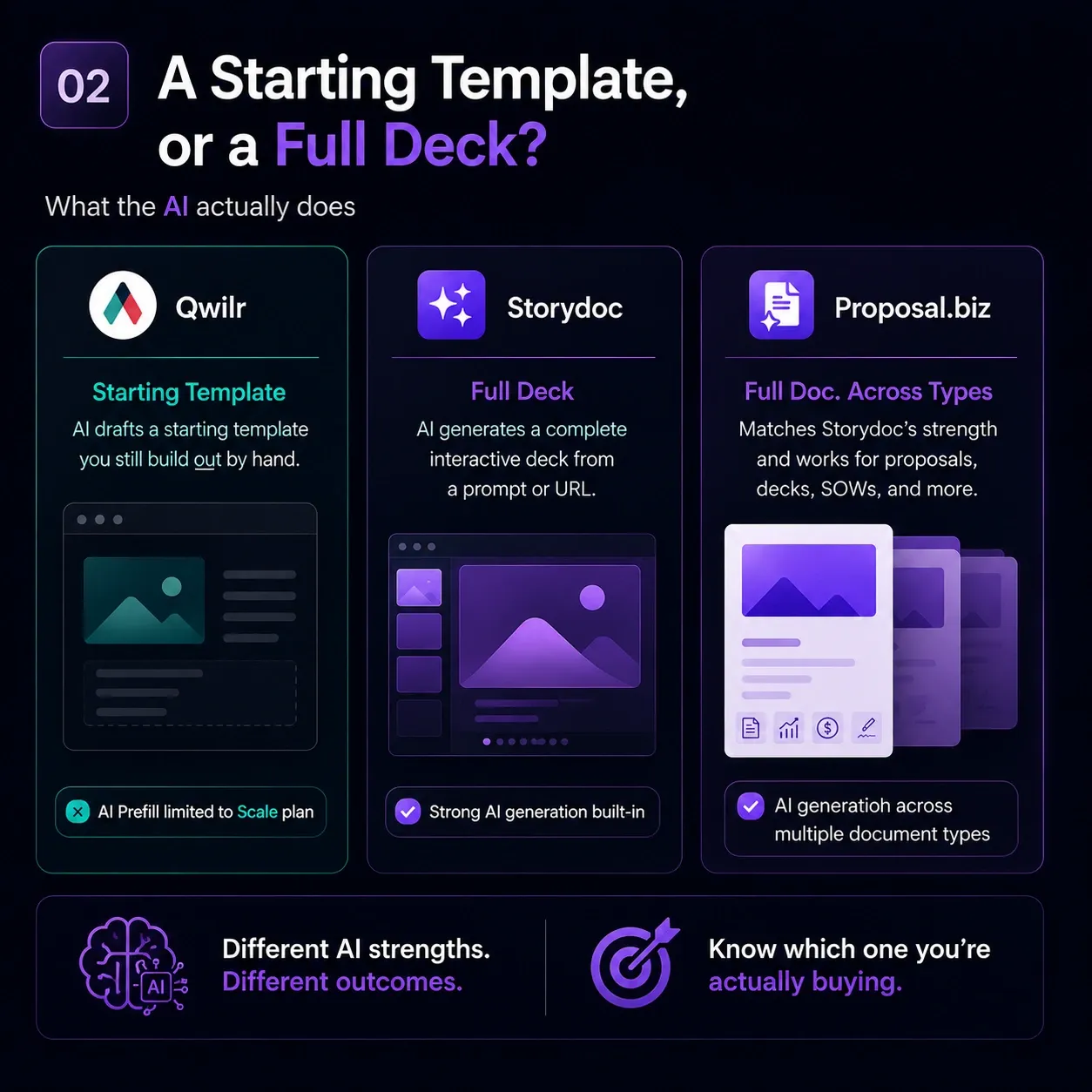
02 · What the AI Actually Does
Qwilr's website-prompted AI drafts a starting template you still build out by hand, and its AI Prefill feature is limited to the Scale plan. Storydoc's AI genuinely generates a complete interactive deck from a prompt or URL, a meaningfully stronger capability.
- Proposal.biz matches Storydoc's generation strength and applies it across proposals, decks, SOWs, and more, not just interactive pages.
Native, or Bolted On?
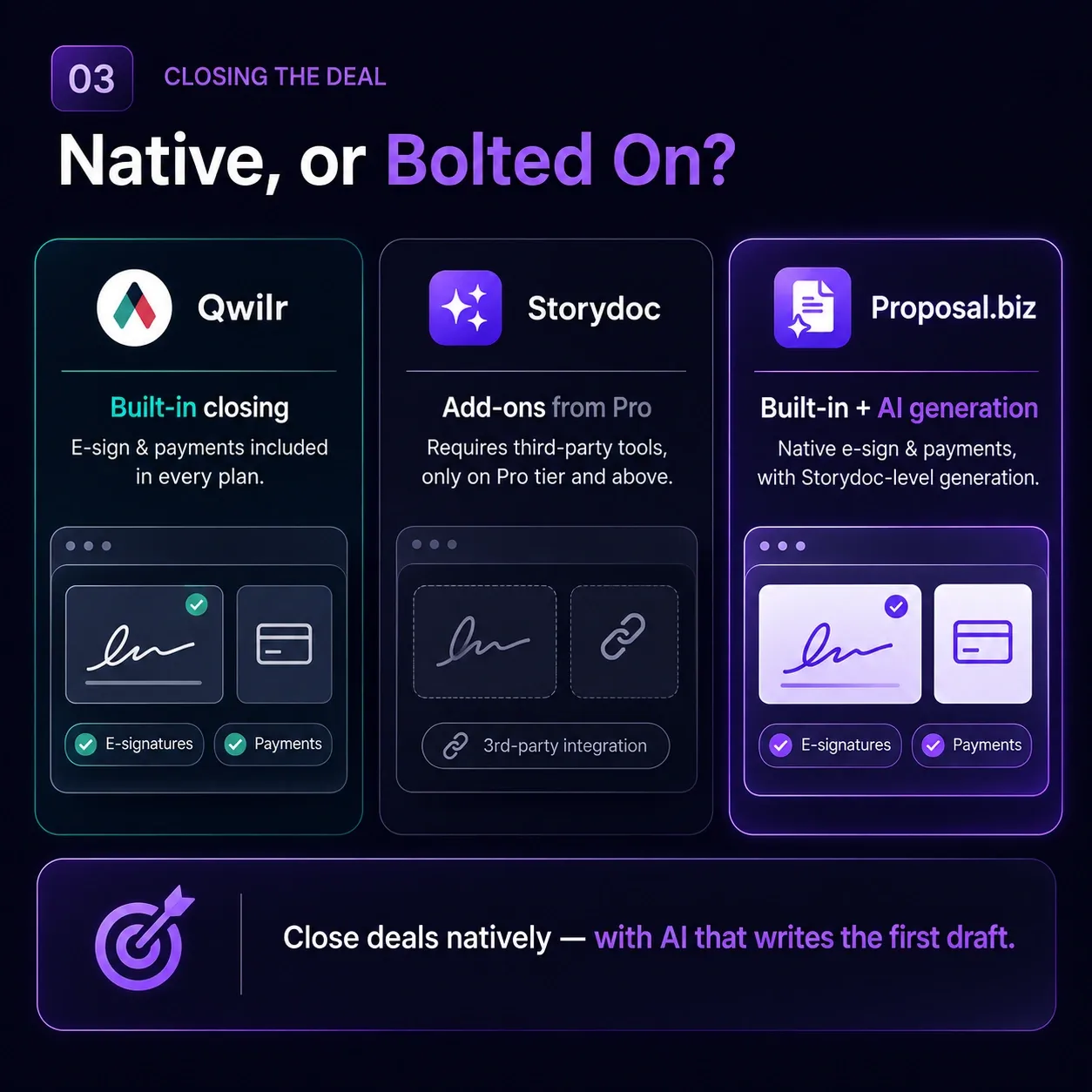
03 · Closing the Deal
Qwilr builds e-signatures and payment collection into every plan, no add-ons or third-party tools required. Storydoc requires connecting a third-party e-signature and payment tool, and only from its Pro tier up.
- Proposal.biz matches Qwilr's native closing and adds the generation strength that matches Storydoc, in the same plan.
Qwilr's Closing, Storydoc's Generation and Analytics.
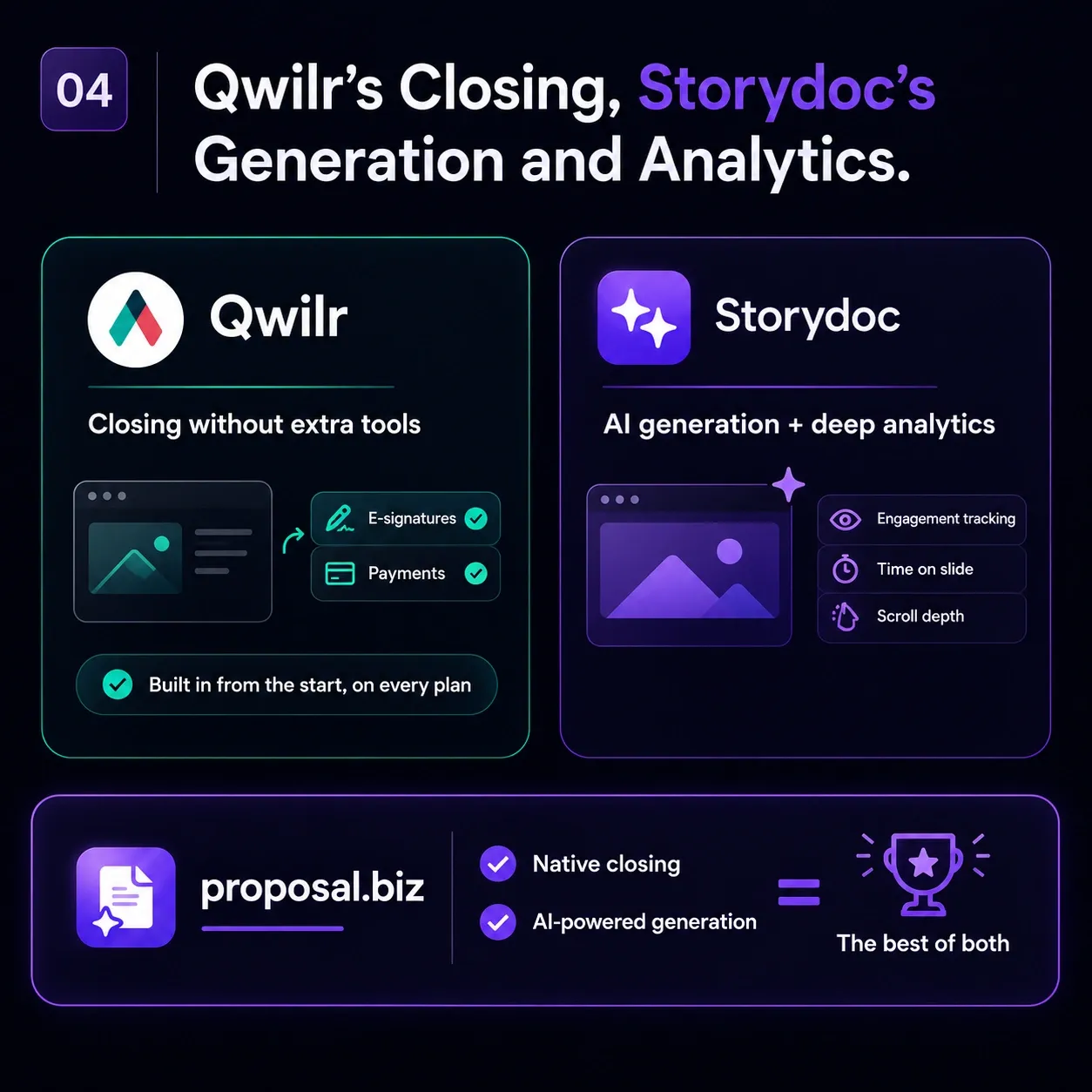
04 · Where Each One Is Strongest
Qwilr's genuine strength is closing without extra tools: e-signatures and payment built in from the start, on every plan. Storydoc's genuine strength is AI-generated, slide-level storytelling with deep engagement analytics.
- Be clear-eyed about which one you're actually buying. A page builder priced by seat minimum with closing built in, and a deck tool priced flat with closing bolted on, solve different problems, and Proposal.biz solves both at once.
Why Teams Choose Proposal.biz Over Qwilr and Storydoc
Same lifecycle as both, create, send, sign, get paid, starting from a faster place and without either one's trade-off.
-
Smart Content Library: Your Brand, Pulled From Your URL, Stored Once
Where Qwilr has you set branding once by hand and Storydoc re-scans your URL per document, Proposal.biz reads your website once and stores logo, colours, fonts, services, pricing, and tone as reusable blocks.
-
The Document, Written for You in Seconds
Qwilr starts you in a block canvas you assemble by hand. Proposal.biz generates the whole branded document from one prompt, matching Storydoc's generation strength across every document type.
-
Edit by Chatting, Not Fighting Constrained Controls or Rebuilding Slides
Ask Document Chat to rewrite, shorten, or retone a section, with no constrained design controls to work around and no slide-by-slide rework.
-
No Seat Minimums or Closing Gaps
Flat plans with a document allowance included and native e-signatures and payment collection mean no forced seats and nothing extra to connect.
-
E-Signatures and Payment, Native on Every Plan
No tier-gating, no third-party integrations: signing and payment collection are included from day one.
-
Every Document Type, One Content Library
Proposals, decks, SOWs, NDAs, retainers, contracts, reports, and more, beyond Qwilr's proposal-and-quote focus or Storydoc's deck-only range.
Pricing Compared
Storydoc vs Qwilr on cost is really two different trade-offs, not a straight fight. All figures reflect published list pricing as of 5 August 2026.
-
Qw
Qwilr
Growth tier, 5-seat minimum
$55 /user/mo
- Included: Interactive proposals and quotes
- Included: CRM integrations from Starter
- Included: E-signatures and payments built in
- Not included: No brand extraction
- Partly included: Limited AI, full generation not available
- Not included: Five-seat minimum applies regardless of team size
-
Sd
Storydoc
Pro tier, billed annually
$36 /mo
- Included: 30 active documents
- Included: CRM integrations and collaboration included
- Included: AI generates full decks from a prompt or URL
- Partly included: E-signatures and payment collection via third-party integration, not native
- Included: Priced per account, not per seat
-
Pb 3 users included
Proposal.biz
Professional, billed annually
$39 /month total
- Included: 3 users, 30 documents, 6,000 AI credits
- Included: AI document generation on every plan
- Included: Automatic brand extraction from URL
- Included: E-signatures and payment collection, native
- Included: Custom domain, branding removed
- Partly included: Monthly document allowance, not unlimited
What a Growing Team Actually Pays
Calculated from published list prices as of 5 August 2026. The Qwilr figures for 3 and 10 users reflect its forced seat minimums, not actual headcount. Storydoc prices per account rather than per seat, so its Pro cost holds flat until a team needs its custom-quoted Team plan.
| Team size | Qwilr | Storydoc | Proposal.biz | You save |
|---|---|---|---|---|
| 1 user | $35/mo | $19.80/mo (Starter, billed annually) | $19/mo | 46% vs Qwilr |
| 3 users | $275/mo (5-seat minimum) | $36/mo (Pro, flat | $39/mo | 86% vs Qwilr |
| 10 users | $750/mo (10-seat minimum) | Custom quote (Team plan required) | $89/mo | 88% vs Qwilr |
Qwilr's Growth and Scale tiers enforce five- and ten-seat minimums, so its real cost for a small team is worse than its sticker price suggests. Storydoc prices per account rather than per seat, so its Pro plan holds flat regardless of headcount, until a team outgrows it and needs the custom-quoted Team tier. Either way, Storydoc's flat price doesn't include e-signatures or payment collection until you add third-party tools on top.
See full pricingWhat the Other Two Do Better
No tool wins every row of a Qwilr vs Storydoc comparison, and Proposal.biz is no exception. Here is exactly where it loses.
Qwilr
- Included: Native e-signatures and payment collection on every plan, no third-party tools or add-ons required
- Included: Genuinely polished, story-driven interactive pages that read closer to a microsite than a document
Storydoc
- Included: Genuinely strong AI-generated interactive decks with deep slide-level analytics
- Included: Real design polish for teams that live and die by deck performance
Who Should Pick Which
The right answer to Qwilr vs Storydoc changes with whether native closing or AI generation quality matters more to you.
-
Freelancers and Solo Consultants
Qwilr's Starter plan at $35 a month works for a single user without hitting a seat minimum, but it has limited AI. Storydoc's Starter plan at $19.80 a month billed annually is cheaper but caps you at 5 documents with no closing tools. Proposal.biz Starter at $19 a month drafts and closes without either trade-off.
- Toss-up: Qwilr Starter or Storydoc Starter, depending on whether native closing or price matters more
-
Agencies and Small Teams of Three to Ten
Storydoc's flat Pro pricing at $36 a month dramatically undercuts Qwilr Growth's $275 a month for a forced five-seat minimum. But Storydoc still needs third-party closing tools on top. Choose Qwilr if native e-signatures and payment matter more than price. Choose Storydoc if AI generation and analytics matter more and you're fine adding a signing tool. Proposal.biz costs $39 a month with everything included.
- Best value with everything included: Proposal.biz Professional
-
Mid-Market Sales Organisations
Qwilr's ten-seat minimum on Scale becomes less painful at this size, so it stays a real option if interactive page design and native closing are central to how you sell. Storydoc's Team tier, a custom quote, becomes the option past five seats for deck-heavy teams.
- Winner: depends on workflow, Qwilr for native closing, Storydoc for AI-generated decks
-
Enterprise and Regulated Industries
Neither tool aims squarely at this level. Storydoc's Team tier adds advanced security controls for larger accounts, and Qwilr does not extend much further past Scale.
- Winner: neither has a strong enterprise play here
Frequently Asked Questions
-
Qwilr is an interactive page builder with native e-signatures and payment collection on every plan, but its Growth and Scale tiers enforce five- and ten-seat minimums. Storydoc is an interactive deck builder with genuinely stronger AI generation, producing a full deck from a prompt or URL, but its e-signatures and payment collection run through third-party integrations that only unlock on its Pro tier and above.
-
It depends on team size. At one user, Storydoc's Starter plan at $19.80 a month billed annually is cheaper than Qwilr's Starter at $35, though Storydoc includes no closing tools at that price. At three users, Storydoc's flat Pro pricing at $36 a month is dramatically cheaper than Qwilr Growth's $275, because Growth's five-seat minimum forces you to pay for two seats you don't have.
-
Storydoc, for AI-generated deck quality specifically. Its editor is purpose-built for interactive, slide-driven presentations with genuinely strong AI generation and deep per-slide analytics. Qwilr leans more toward interactive sales pages and proposals than presentation-style decks.
-
Storydoc, clearly. It produces a full interactive deck from a prompt or URL. Qwilr's website-prompted AI drafts a starting template you still build out, and its AI Prefill feature is limited to the Scale plan. Proposal.biz is the only one of the three that generates a complete branded document with native e-signatures and payment included from the same prompt.
-
Not natively. Storydoc offers e-signatures through a third-party integration, available from its Pro tier up. Qwilr includes e-signatures on every plan, including its Starter tier. Proposal.biz also includes native e-signatures on every plan.
-
Storydoc, by a wide margin on the sticker price. It prices per account rather than per seat, so its Pro plan holds at $36 a month for a small team, versus Qwilr's $275 a month for three seats on Growth due to its five-seat minimum. Factor in the cost of the closing tools Storydoc requires you to add, and the real gap narrows.
-
Proposal.biz covers the same lifecycle of create, send, sign, and get paid, but is the only one of the three with both native e-signatures and payment collection on every plan and AI generation strong enough to draft a complete document from a prompt.
-
Not equally. Qwilr and Proposal.biz include native e-signatures on every plan. Storydoc offers e-signatures only through a third-party integration, and only from its Pro tier up. Proposal.biz records signed status and signing date and sends a confirmation email to both parties.
See the Difference in 60 Seconds
Paste your website URL. Watch Proposal.biz read your brand and draft a complete, branded document, signed and paid in the same window, before you've finished connecting a third-party tool anywhere else. No card required. Every plan includes AI generation, e-signatures and payments.
Free forever - No credit card.